Panacea Bio ChemPopulation-Genomics Data ReviewDATASET · HUMAN GENOME DIVERSITY WITHIN-POP VARIANCE ≈ 85% · FST≈ 0.12
Population Genetics · Human Variation · Review
Human genetic variation and population genetics: why biological “race” is not a scientific category
Human populations do differ genetically — in ways that genuinely help medicine. But those differences are gradual and overlapping, and the great majority of variation sits within each population. Read at the level of the genome, folk “race” simply is not a natural biological category. Here is the honest picture: the data, the history, and why population-aware medicine still matters.
Panacea Bio Chem Ltd. / A science review by Bogdan Dicoias, Scientist
/ Field: population & medical genetics / Class: educational science / Updated 2026-07-17
>99.9%
of the genome is shared between any two people
≈85%
of variation lies within a single population
≈0.12
FST between major human groups — low, and clinal
0
discrete, sharp-edged biological “races” in the data
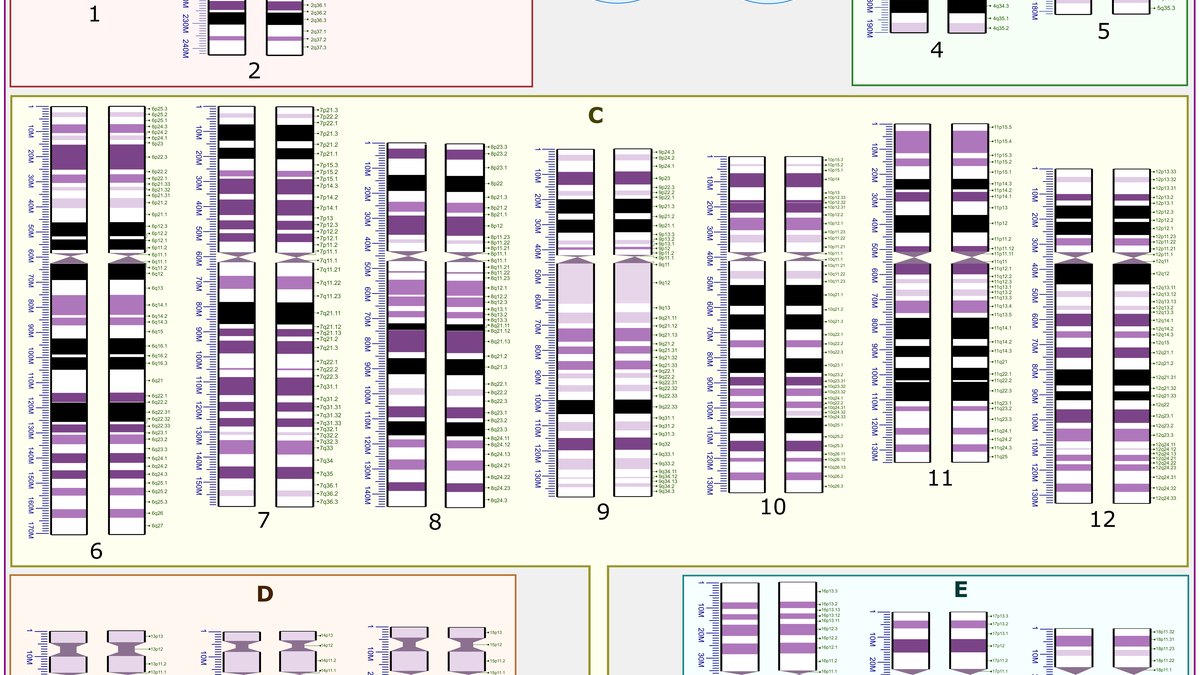
A human karyotype — the 23 chromosome pairs. Population genetics reads variation across this whole genome, and finds that most of it separates individuals within a group, not one group from another. A review by Panacea Bio Chem, Bogdan Dicoias.
Abstract
Modern population genetics gives a clear, consistent answer to an old question. Human beings vary genetically, and some of that variation differs in frequency from one region to another — usefully so for medicine. Yet three robust findings dismantle the idea of biological “race”: (1) the genome is more than 99.9% identical between any two humans; (2) of the small remainder, roughly 85% varies within any single population, leaving only about 15% between groups; and (3) that between-group variation is clinal — it grades smoothly across geography rather than falling into discrete blocks. What is real and actionable are differences in allele frequency: they drive HLA tissue-matching and pharmacogenomics, and they reward population-aware, individually-genotyped medicine. This review sets out that evidence, the history it corrected, and where the frontier now lies.
In one minute
The genome is overwhelmingly shared. More than 99.9% is identical between any two people.
Most variation is within groups. About 85% of human genetic variation is found inside any single population — the classic apportionment (Lewontin 1972).
Variation is clinal, not blocky. Allele frequencies change gradually across geography, so lines drawn for “races” cut through continuous gradients.
Real differences still matter. Allele-frequency differences make HLA matching and pharmacogenomics work — population-aware medicine, using continuous ancestry and individual genotype, helps patients.
Molecular “compatibility” is between individuals. HLA scent preference, KIR/HLA-C in pregnancy and Rh/ABO blood groups track each person's own immune genotype — which varies within every population and does not track race.
01 · What population genetics actually measures
Frequencies, not essences
A useful first move is to notice what geneticists count. They do not sort people into
kinds and then ask how the kinds differ. They pick a spot in the DNA where humans vary —
a single-nucleotide polymorphism, or SNP — and measure how common each version
(each allele) is in a sample. Repeat across hundreds of thousands of such spots and you
get a portrait of a population as a set of allele frequencies.1
Framed this way, a “population” is just a group of people who tend to have children
together, so their allele frequencies drift in step. Populations are real, fuzzy-edged and nested
— a village inside a region inside a continent. Crucially, they are defined by how common
a variant is, never by any variant being wholly present in one group and wholly absent in another.
Almost every common human variant is found, at some frequency, almost everywhere.
02 · The apportionment of human diversity
Most of the difference is between neighbours, not between continents
In 1972 the geneticist Richard Lewontin partitioned human genetic variation into three levels:
within a local population, among populations of the same region, and among major geographic
regions. The result has held up across five decades and vastly larger datasets. The lion's share
of all human genetic variation — about 85% — is found within a single
local population. Only a small slice distinguishes one broad region from another.2
Only about 15% of human genetic variation lies between groups at all — and most of even that is between nearby populations, not between continents. The fixation index FST that summarises this sits near 0.12, a low value for a species.2
What about the counter-point people often raise — that computers can sort DNA into
continental clusters? They can, and this is not a contradiction. In 2002 Rosenberg and colleagues
showed that clustering algorithms fed many hundreds of markers recover groups that roughly track
the major continents.3 But three things temper that headline. The
clusters emerge only by pooling information across very many loci, each individually a poor
discriminator; individuals receive fractional, mixed membership rather than a clean label;
and when sampling is spread evenly across geography rather than in continental clumps, the apparent
clusters dissolve back into gradients.4 Structure is real;
discrete races are not what produces it.
You can always draw a line on a gradient. That the line can be drawn does not make it a natural boundary.
03 · Variation is clinal, not discrete
Gradients, isolation-by-distance, and why boundaries are choices
The deepest reason “race” fails as biology is the shape of human variation.
Because people have always married neighbours a little more than strangers, and migrated in every
direction, genetic similarity falls off smoothly with distance — a pattern population
geneticists call isolation-by-distance. Allele frequencies therefore form clines:
continuous gradients across the map, each gene with its own gradient pointing its own way.5
Illustrative shape only. Because each gene has its own independent cline, dividing the gradient in one place for one trait contradicts where you would divide it for another — which is exactly why fixed “racial” boundaries do not correspond to the biology.
And the gradients for different genes do not line up. Skin-pigment alleles trace UV
latitude; malaria-resistance alleles trace the historical range of the parasite; lactase
persistence traces herding history. Sort people by one and you get one grouping; sort by another
and the grouping reshuffles. There is no single seam along which humanity naturally splits —
the seams point everywhere at once, which is the signature of continuous variation. On this basis
scientific bodies including the American Association of Biological Anthropologists (AAPA) state
plainly that race is a social classification, not a natural division of the species.6
The scientific bottom line
Folk “race” is not a biological category. The genome is shared, the variation is
mostly within-group, and what lies between groups is a set of overlapping gradients. This is the
mainstream position — and it is the opposite of any claim that ancestry sets
behaviour, intelligence, temperament or human worth. Those claims have no support in this biology.
04 · The history, told cleanly
How typology was replaced by clines
For much of the 19th and early 20th centuries, a “science” of race assumed humanity
fell into a few fixed types, each with an essence, arranged in a ranking. It measured skulls,
drew charts, and mistook its own categories for facts of nature. It was wrong on the science,
not merely objectionable: it assumed sharp boundaries where the data show gradients, essences where
the data show frequencies, and ranks where the data show adaptation to different local
environments.7
What replaced it was not opinion but measurement. Blood-group surveys in the mid-20th century
already showed every “race” sharing the same alleles at differing frequencies. Lewontin's
1972 apportionment quantified how little lies between groups. The Human Genome Project and the great
diversity panels — the HapMap, the 1000 Genomes Project, the Human Genome Diversity Project
— then mapped variation genome-wide and confirmed the same shape: a continuum, richly
structured by history and geography, with no discrete racial partitions.8
Typology did not lose an argument; it lost to the data.
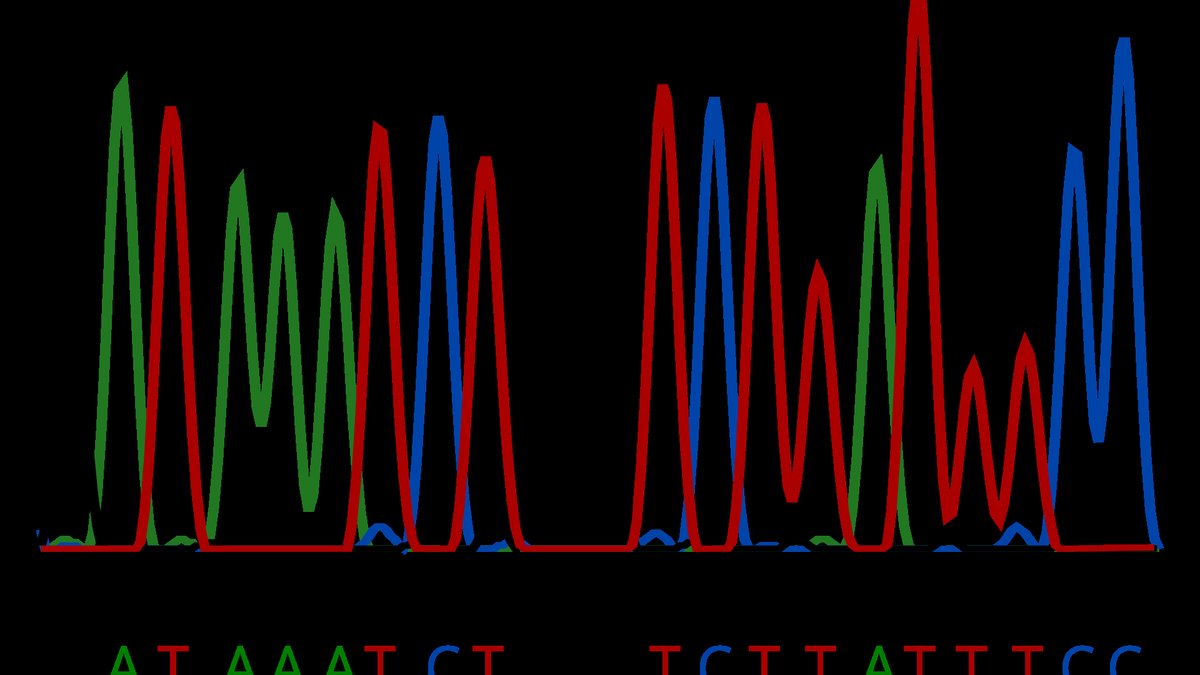
A DNA sequencing trace. Reading the sequence itself — base by base, person by person — is what turned the old typology into measurable allele frequencies and clines. A review by Panacea Bio Chem, Bogdan Dicoias.
05 · Where allele frequencies genuinely matter — population-aware medicine
Real differences, used to help individual patients
None of the above means ancestry is medically irrelevant. Quite the reverse: because allele
frequencies differ between populations, ignoring that variation can leave patients worse served.
The honest framing keeps two truths together — the differences are real and useful,
and they are frequencies, not fixed racial traits. Population-aware medicine therefore aims
at continuous genetic ancestry and, wherever possible, the individual's own genotype, rather
than a folk label read from appearance.
HLA diversity — transplant and marrow matching
The HLA genes of the major histocompatibility complex are the most polymorphic in the
human genome, with thousands of alleles.9 They are how the immune
system tells self from non-self, so a transplanted organ or a donated marrow graft takes far better
when donor and recipient share HLA types. Because particular HLA alleles and haplotypes occur at
different frequencies across populations, patients are most likely to find a close match among
donors of similar ancestry — which is precisely why worldwide marrow registries work to
recruit ancestrally diverse donors, so that no patient group is left short of matches. Here
human genetic diversity is not a problem to explain away; it is a resource that saves lives when the
donor pool is broad enough.
Pharmacogenomics — the right dose for the person
The enzymes that process medicines are encoded by genes that vary between people, and the
frequency of each variant differs across ancestries. Testing an individual's genotype lets a
clinician anticipate how they will handle a drug — the core of pharmacogenomics.10
Pharmacogenomic marker
Gene
Why it matters clinically
Abacavir hypersensitivity risk
HLA-B*57:01
Carrying this allele is strongly linked to a serious hypersensitivity reaction to the HIV drug abacavir; pre-treatment genotyping is standard practice. The allele's frequency differs markedly by ancestry, so testing the individual — not assuming from group — is the point.
Clopidogrel & PPI response
CYP2C19
No-function variants make a person a poor metaboliser; the frequency of the poor-metaboliser phenotype is higher in East Asian populations than in European ones, altering how some drugs are activated or broken down.
Metaboliser status (many drugs)
CYP2D6
This highly variable gene spans poor to ultrarapid metabolisers; the proportions differ across populations, which is why dose-critical drugs increasingly pair with a genotype test.
Warfarin dose requirement
VKORC1 · CYP2C9
Common variants shift the anticoagulant dose a patient needs; their frequencies differ by ancestry, and genotype-guided dosing algorithms fold this in to reach a stable dose sooner.
Approximate, literature-derived figures for broad reference groups, shown to illustrate the pattern, not to label any individual (*African lactase-persistence frequencies vary widely with local herding history). Notice the shape: frequencies shift between groups, but almost every variant is present in every group — these are dials, not switches. That is exactly why the responsible clinical move is to test the person, since a group average never determines an individual's genotype.10
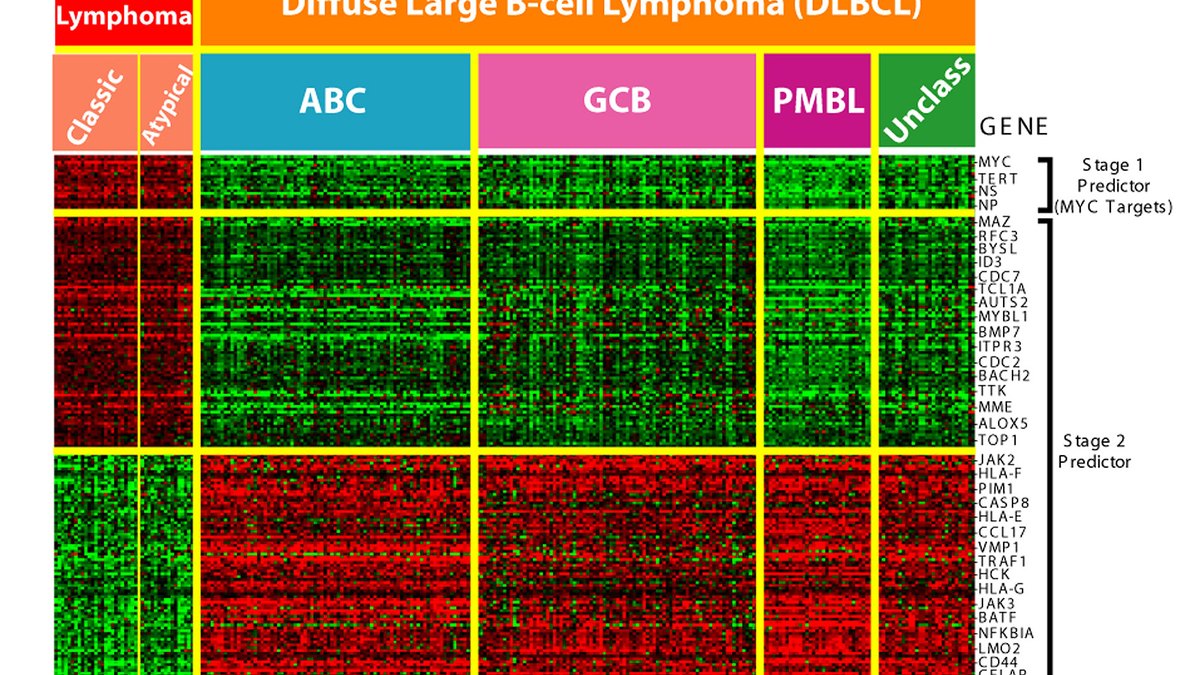
A DNA microarray heatmap. High-throughput genomics reads thousands of loci at once — the tooling that measures allele frequencies, powers pharmacogenomics, and lets medicine work with real human diversity. A review by Panacea Bio Chem, Bogdan Dicoias.
Many of these medically-relevant differences are the same adaptations that shaped human
populations over millennia — malaria-resistant blood, lactase persistence, altitude oxygen
handling. That deeper adaptation story is told in its own right in
Bio-Ethnicity — human genetic adaptation →,
a companion Panacea review. Together they make one point: human diversity is a record of adaptation
and a resource for medicine — never a ladder.
06 · Molecular compatibility between individuals
When immune genes meet — a story about people, not peoples
There is a genuinely deeper layer to this biology, and it is one of the most
fascinating corners of human genetics: at the molecular level, two individuals
can be more or less compatible — in the scent one carries for another, in
how a pregnancy is built, in whether a transfused or transplanted tissue is accepted.
The molecule at the centre of nearly all of it is the same one that makes transplants
hard: the HLA/major-histocompatibility complex (MHC), the most polymorphic region
in the human genome.9 Because every person inherits a highly
individual set of HLA alleles, this compatibility is measured between two specific
people — and, as we will see, it does not track race or continent. It is
the individual genotype that matters, full stop.
The scent of the immune system — MHC-disassortative preference
In a now-classic 1995 experiment, Claus Wedekind and colleagues had women rate the odour
of T-shirts worn by different men. On average, women tended to rate the scent of men whose
MHC differed from their own as more pleasant — a hint that the immune genotype
leaks into body odour and into attraction.12 A follow-up
refined the picture toward a preference for MHC dissimilarity/heterozygosity rather
than any single “ideal” type.12 Independently,
Carole Ober's study of several hundred Hutterite couples — a population that
nonetheless marries across many HLA types — found spouses shared HLA haplotypes
less often than chance would predict, a small but real disassortative
signal.13
Two hypotheses are usually offered for why such a preference could exist: the
heterozygote-advantage idea (children with a wider HLA repertoire may present a
broader range of pathogen peptides to the immune system) and simple inbreeding
avoidance (HLA type is a convenient marker of overall genetic relatedness). Both remain
hypotheses.
Honesty demands the nuance, because the literature is genuinely mixed. A large
2008 analysis by Chaix and colleagues found an MHC-dissimilarity signal in mate choice among
European-American couples but not in a Yoruba (Nigerian) sample — the effect
was present in one population and absent in another.14 Several
other studies report null results, and the Wedekind finding itself reversed among
women taking the oral contraceptive pill. Careful reviews conclude the human MHC-mate-choice
effect is real but weak, inconsistent and context-dependent — not a law of
attraction.15 The interesting, non-obvious point stands: to the
extent the effect exists at all, people lean toward immune-gene difference.
Building a pregnancy — HLA sharing and maternal–fetal KIR/HLA-C
The same immune molecules matter at the very start of life, and here the biology is firmer.
Couples who happen to share an unusual number of HLA alleles show, in several studies,
somewhat elevated rates of recurrent pregnancy loss and pre-eclampsia — a
hint that some immunological difference between mother and fetus helps a pregnancy
implant and grow.16 The mechanism was made concrete by Ashley
Moffett, Susan Hiby and colleagues: at the placenta, the mother's uterine natural-killer
cells read the fetus's HLA-C using their KIR receptors, and this
KIR × HLA-C pairing helps govern how deeply the placenta invades and
remodels the mother's blood supply. Mothers with the inhibitory KIR AA genotype
carrying a fetus with the HLA-C2 group face a higher risk of pre-eclampsia and growth
restriction, while activating KIR (such as KIR2DS1) are protective.17
This is real molecular “compatibility” biology — and, crucially, it is a
property of which two individuals conceive, since both the maternal KIR haplotype and
the paternal/fetal HLA-C group vary widely inside every population.
The hard maternal–fetal incompatibility — Rh and ABO blood groups
The cleanest example of a true molecular incompatibility is a blood-group one. When an
RhD-negative mother carries an RhD-positive fetus, she can make anti-D
antibodies that cross the placenta and attack fetal red cells — haemolytic disease of
the fetus and newborn (HDFN). Before intervention, RhD sensitisation complicated a
meaningful share of at-risk pregnancies and was a serious cause of fetal loss and newborn
jaundice.18 The story is also one of medicine's great wins: from
the late 1960s, anti-D immunoglobulin (given to RhD-negative mothers) cut the rate of
sensitisation from roughly 13–16% of susceptible pregnancies to about
1–2% — a molecular incompatibility largely engineered out of existence. A
milder analogue, ABO incompatibility, is common but usually gentle.
And note what governs it: the frequency of RhD-negative status differs by ancestry
— roughly 15–17% in Europeans, about 3–5% in sub-Saharan
Africans and under 1% in many East Asian populations — yet whether a given
pregnancy is at risk depends entirely on the two individuals involved, never on their
“race.” It is a mother's genotype meeting her own fetus's genotype.
Is there a human “pheromone”? — the honest state of the evidence
Because MHC information appears to reach the nose, it is tempting to imagine a specific
human sex “pheromone” molecule. Here the science asks for restraint. Axillary
(underarm) secretions do carry some MHC-linked chemical information, and MHC peptide ligands
have been detected in body fluids — so an immune signal in scent is plausible.
But the widely marketed candidate molecules (androstadienone, estratetraenol and
similar steroids) have weak and contested support: rigorous work, notably Tristram
Wyatt's, argues that no human pheromone has yet been identified to the chemical
standard routinely met in other animals.19 The honest summary:
scent may carry immune-gene information, but claims of a bottled human “attraction
molecule” are not supported by the evidence.
Compatibility here is between two people's immune genes — and the preferred, easier direction is difference, not sameness.
Schematic. Every population holds a wide scatter of HLA types, and the same types recur across populations — so HLA/immune compatibility is a fact about two individuals' genotypes, not about their ancestry. If anything, MHC-dissimilarity — statistically a little more likely between distant populations — is the preferred, compatible direction in the mate-choice literature.
The accuracy anchor — and it keeps the thesis intact
Every compatibility effect on this page — scent preference, HLA sharing in
pregnancy, KIR/HLA-C placentation, Rh/ABO blood groups — tracks an individual's
HLA/immune genotype, which varies enormously within every population and overlaps
across all of them. None of it tracks race or continental ancestry. In fact the mate-choice
literature points the other way: MHC-dissimilarity — statistically a little more
likely between distant populations — is the preferred, compatible direction, not
an incompatible one. So “compatibility” is an individual-genotype
phenomenon and is not a race-level one. This is fully consistent with the rest of the
review: folk “race” is not a biological category, and nothing here implies that
different populations are inherently incompatible or in any molecular conflict — they
are not. Any such claim has no support in this biology.
07 · Why it matters — the open frontier
Reading human variation correctly is not only a matter of getting the science right; it changes
what medicine can do. The frontier is to describe ancestry as it really is — as continuous
axes of genetic ancestry rather than boxes — and to build the diverse reference panels
that let genomic medicine serve everyone equally well. Most large genetic studies have historically
over-sampled European-ancestry participants, which means polygenic scores and some clinical tools
transfer poorly to under-represented groups. Widening that base is one of the most consequential
tasks in genomics, because it turns human diversity from a blind spot into an asset.11
Do it well and the same variation that once fuelled a false hierarchy becomes the foundation of
medicine that fits each person.
08 · Where Panacea Bio Chem works
Panacea Bio Chem works at the molecular layer where this diversity becomes practical:
precision biochemistry and amino-acid-chain (AAC) design. Human molecular variation is the
real backdrop against which any peptide or biologic has to perform — a receptor variant here,
a metabolising-enzyme variant there — so the same population-genetic thinking that shows why
“race” is not biology also informs how a research-grade molecule is designed to work
gracefully across the breadth of human physiology, and how it is kept structurally whole from
synthesiser to patient. That gentle preservation runs through methods such as
Cryolapse™ — gentle freeze-drying →,
TgShift™ — raising the stability ceiling → and
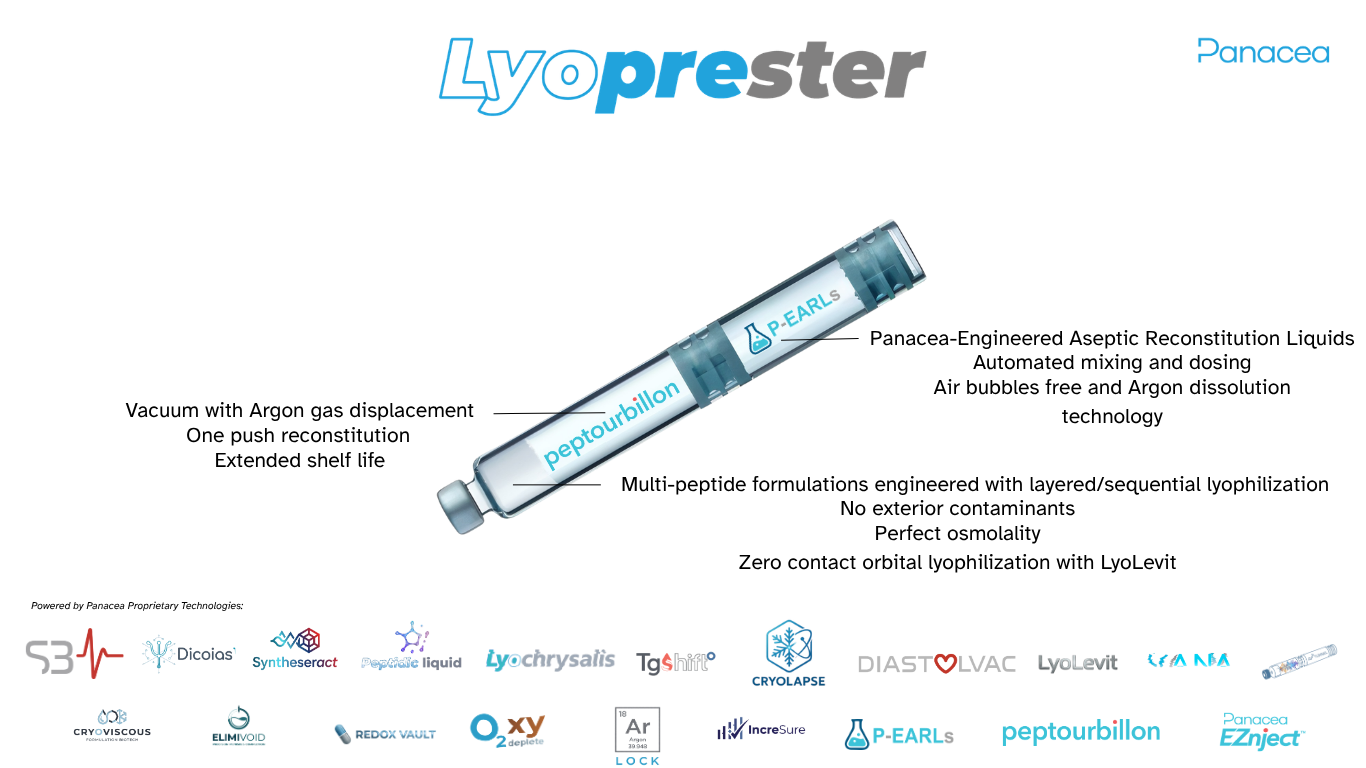
RedoxVault™, delivered through the self-reconstituting
Lyoprester® cartridge → and coordinated by the
S3Pulse™ biointegrity algorithm →.
Panacea's ongoing work treats human molecular diversity as design context, not as a hierarchy.
The specific proprietary methods, parameters and
in-house research directions that Panacea Bio Chem brings to this sphere remain held by the company
and its founder, Bogdan Dicoias — the outline is public; the working detail stays in-house.
Bogdan Dicoias — Scientist and Director of Panacea Bio Chem, biochemist and
amino-acid-chain (AAC) designer. He works largely out of view on precision biochemistry, peptide
design and gentle biopreservation — work whose methods reach quietly across the
pharmaceutical industry.
09 · Potential directions
Population-aware molecule design — accounting for common enzyme and receptor variants (of the CYP2C19 or CYP2D6 kind) when designing research-grade peptides and their formulations.
Continuous-ancestry modelling — treating genetic ancestry as smooth axes rather than boxes when reasoning about how a molecule behaves across diverse physiology.
Diverse reference data — supporting broader, more representative genomic reference sets so that precision tools serve every patient group.
Preservation across diversity — keeping a fragile biologic structurally whole, with its binding profile intact, for every recipient whatever their molecular background.
These are open research directions offered as inspiration, not results or health claims.
Frequently asked
Is race a biological category? No. Most human genetic variation (~85%) lies within
any single population, and between-group variation grades clinally across geography rather than
forming discrete blocks. Scientific bodies such as the AAPA describe race as a social
classification, not a natural biological division. What is real are differences in allele
frequency — useful in medicine, but not bounded “races”.
If race is not biological, why do ancestry and medicine still matter? Because allele
frequencies genuinely differ between populations. That is why HLA matching for transplants works
best with diverse donor pools, and why pharmacogenomic markers (HLA-B*57:01, CYP2C19, CYP2D6,
VKORC1/CYP2C9) occur at different frequencies across ancestries. Population-aware medicine uses
continuous ancestry and, ideally, the individual's own genotype — never a folk label.
What did old “scientific racism” get wrong? It assumed a few fixed, ranked
“types” with sharp boundaries. Genomics overturned that: the genome is more than 99.9%
shared, variation is mostly within-group and clinal, and no discrete biological races exist. Any
claim tying ancestry to behaviour, intelligence, temperament or worth is pseudoscience,
contradicted by the biology.
Is there molecular “compatibility” between individuals — and does it track race? Yes
to the first, no to the second. Real HLA/immune-gene effects exist between two people: an
MHC-disassortative scent preference (real but weak and inconsistent), HLA sharing linked to
recurrent pregnancy loss and pre-eclampsia, maternal KIR × fetal HLA-C in placentation
(Hiby et al.), and the classic Rh/ABO blood-group incompatibility that anti-D prophylaxis
largely solved. Every one of these tracks the individual's HLA genotype, which varies
enormously within every population — not race. If anything, MHC-dissimilarity is the
preferred, compatible direction, so this is an individual-genotype phenomenon, never a
race-level one.
Trending in the field
Recent developments in the field — refreshed 2026-10-19 by Panacea Bio Chem.
Rosenberg, N.A. et al., "Genetic structure of human populations," Science 298:2381–2385 (2002). PubMed.
Serre, D. & Pääbo, S., "Evidence for gradients of human genetic diversity within and among continents," Genome Research 14:1679–1685 (2004). PubMed · Rosenberg et al. (2005) on clines vs clusters. PubMed.
The 1000 Genomes Project Consortium, "A global reference for human genetic variation," Nature 526:68–74 (2015). Nature · Human Genome Diversity Project.
HLA — the human leukocyte antigen system and its polymorphism in transplantation. Wikipedia · NCBI Bookshelf.
Diversity in genomic studies and the transferability of polygenic scores. Martin, A.R. et al., Nature Genetics 51:584–591 (2019). PubMed.
Wedekind, C., Seebeck, T., Bettens, F. & Paepke, A.J., "MHC-dependent mate preferences in humans," Proc. R. Soc. Lond. B 260:245–249 (1995). PubMed · Wedekind, C. & Füri, S., "Body odour preferences in men and women… heterozygosity?" Proc. R. Soc. Lond. B 264:1471–1479 (1997). PubMed.
Ober, C. et al., "HLA and mate choice in humans," Am. J. Hum. Genet. 61:497–504 (1997). PubMed.
Chaix, R., Cao, C. & Donnelly, P., "Is mate choice in humans MHC-dependent?" PLoS Genetics 4:e1000184 (2008) — effect seen in European-Americans but not a Yoruba sample. PubMed.
Havlíček, J. & Roberts, S.C., "MHC-correlated mate choice in humans: a review," Psychoneuroendocrinology 34:497–512 (2009) — concludes the effect is real but weak and inconsistent. PubMed.
Hiby, S.E. et al., "Combinations of maternal KIR and fetal HLA-C genes influence the risk of preeclampsia and reproductive success," J. Exp. Med. 200:957–965 (2004). PubMed · Hiby, S.E. et al., "Maternal activating KIRs protect against human reproductive failure mediated by fetal HLA-C2," J. Clin. Invest. 120:4102–4110 (2010). PubMed.
Wyatt, T.D., "The search for human pheromones: the lost decades and the necessity of returning to first principles," Proc. R. Soc. B 282:20142994 (2015). PubMed · Androstadienone — Wikipedia.
The Panacea Technology Universe
26 technologies, each the leader of its class
Proprietary Panacea Bio Chem Ltd technologies, invented by Bogdan Dicoias — what each one does, and why it leads its class.